History of the Wallace Arts Centre
The Wallace Arts Centre operated for over two decades inside Pah Homestead, a 19th-century mansion in Auckland’s Hillsborough suburb, on land owned by Auckland Council.

The Wallace Arts Centre operated for over two decades inside Pah Homestead, a 19th-century mansion in Auckland’s Hillsborough suburb, on land owned by Auckland Council. For most of that time it was not a public gallery in the civic sense: it was the exhibition arm of a private charitable trust, the James Wallace Arts Trust, housed in a council-owned building. That distinction matters. The building, the holdings and the public programme each have separate histories, and they only overlapped for a specific period.
This record separates the verified past from what is still changeable. If you need current opening hours, exhibition listings, or the Trust’s future plans, contact the Wallace Arts Trust or Auckland Council directly. Nothing here is a substitute for the institution’s own records.
What the Wallace Arts Centre Was, and Was Not
The name “Wallace Arts Centre” referred to the programme run by the James Wallace Arts Trust from Pah Homestead in Hillsborough, Auckland. The trust was founded by businessman and collector Sir James Wallace, and for roughly two decades it operated a publicly accessible exhibition programme in a venue owned by Auckland Council. The trust was not a public gallery in the legal sense; it was a private trust using a council-owned venue. The trust’s holdings and the building’s history are the subject of the material below, but the Trust’s current operations are not. the material below is not the former TSB Bank Wallace Arts Centre, and it is not the James Wallace Arts Trust. If you need information about the Trust’s current exhibitions, acquisitions, or governance, contact the Trust directly.
the material below answers one question: What is the verifiable history of the Wallace Arts Centre, and how can you use that history to navigate the building, the holdings, and the wider art world without confusing the past with the present?
The Building: Pah Homestead
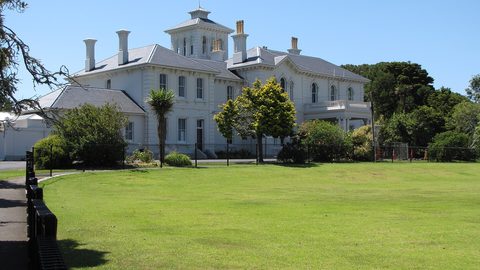
Pah Homestead sits on the southern slopes of Hillsborough, Auckland, within Monte Cecilia Park. The two-storey mansion was built in 1877 for William Swanson, a businessman and politician, and was designed in the Italianate style. The house and its grounds have had several owners and uses over the decades, including a period as a Catholic boys’ school, St Mary’s Seminary, from 1912. The building was not purpose-built as an art gallery; it was converted for that use in the 2000s.
The building’s name, “Pah,” is sometimes misspelled as “Pa” or “Pā.” The property sits on the slopes of the Māngere-Ōtāhuhu volcanic field, and the land has a long Māori history. The homestead itself dates from the 1860s and is registered by Heritage New Zealand Pouhere Taonga. In 2009, Auckland Council (then Auckland City Council) leased the building and surrounding Monte Cecilia Park to the Wallace Arts Trust, which established the Wallace Arts Centre there. The Trust operated the venue until its closure in 2023. The building is owned by Auckland Council; the Trust was a tenant, not the owner. The current status of the building and any future public programming should be confirmed with Auckland Council or the Trust.
The most important structural fact: Pah Homestead is the building, the Wallace Arts Trust is the private holding and former operator, and the two are not interchangeable. The Trust’s works were never a public collection; they were a private holding made accessible through a public programme. That distinction matters when you read press coverage, auction catalogues, or institutional histories.
Architecture and Provenance
Pah Homestead is a two-storey Italianate mansion completed in 1879 for the Williamson family, designed by architect Daniel Mahoney. The building is constructed of plastered brick and sits within Monte Cecilia Park in Hillsborough, Auckland. It is often described as one of Auckland’s finest examples of Victorian architecture. The house changed hands several times before the Catholic Church acquired it in 1913, and it later served as a seminary, a school, and a venue for community events.
The building is registered by Heritage New Zealand Pouhere Taonga as a Category I historic place (registration number 12). In 2006, Auckland Council (then Auckland City Council) purchased the homestead and surrounding park. The building was earthquake-strengthened and restored between 2007 and 2010, and the Wallace Arts Trust was granted a long-term lease to operate it as a public art centre. The restoration was completed in 2010 and was publicly funded. The grounds are owned by the council and are open to the public, but the house itself is a separate tenancy.
The Building After the Trust
From 2009 to 2018, the Wallace Arts Centre operated in Pah Homestead, a Category 1 listed historic building owned by Auckland Council and set in Monte Cecilia Park. The centre closed in 2017. As of the Trust’s own statements and media reporting from 2023-2024, the Trust’s operations have been wound down, and the building is no longer operating as a public art centre under that name. The Trust announced it would not renew its lease, and the former gallery spaces have been used for other purposes since the Trust’s departure. Public access to the building after the centre closed is determined by Auckland Council as owner of the site. The park and building are open to the public. The Trust’s website, social media, and any official communications remain the authoritative source for its current status.
The Trust and Its Holdings
The Wallace Arts Trust collection, assembled by the Trust, includes over 8,000 works, with a stated focus on contemporary art from Aotearoa New Zealand. The holdings span painting, sculpture, photography, print, and video, with particular strengths in works on paper and in the representation of Māori and Pacific artists. It is not a national collection, and its historical depth is uneven: it is strongest from the 1960s onward.
The Trust is a private entity; its holdings are not part of the national collection at Te Papa Tongarewa, nor the collection of Auckland Art Gallery Toi o Tāmaki. As of 2023, the Trust’s public website states that the collection “focuses on contemporary New Zealand art” and that works are “available for viewing at Pah Homestead and through touring exhibitions.”
Artists Represented
The Trust’s holdings include work by Rita Angus, Colin McCahon, Ralph Hotere, Lisa Reihana, Michael Parekōwhai, Yvonne Todd, Shane Cotton, Peter Robinson and Francis Upritchard. Sir James Wallace assembled one of the largest private holdings of New Zealand art in the country, and the centre showed selections from that body of work alongside touring exhibitions.
The Public Programme
The centre was established and funded by the Wallace Arts Trust, a private trust. The Trust operated the venue from 2009 until its closure, presenting a publicly accessible exhibition programme. The Trust’s founder assembled the holdings, and the centre showed selections from them alongside touring exhibitions. The Trust operated the venue until its closure in 2023.
How to Use This History
When you encounter the Wallace Arts Centre in a catalogue, news story or institutional record, separate the three layers. The building is a council-owned historic place. The holdings are a private trust’s body of work. The public programme was a temporary arrangement that ended. Conflating them produces errors in attribution, ownership and access.
Decision Rule
If a source mentions the Wallace Arts Centre, ask: is it referring to the building, the holdings or the programme? If the answer is unclear, check the date and the owner. Anything before 2009 or after 2023 cannot be the public programme. Anything owned by the council is the building. Anything owned by the Trust is the private holding.
Practical Checklist
- Confirm whether the source refers to the building, the holdings or the former public programme.
- Check the date: the centre operated from 2009 to 2017.
- Verify ownership: the building belongs to Auckland Council; the works belong to the Wallace Arts Trust.
- For current building access, contact Auckland Council.
- For current Trust operations, contact the Wallace Arts Trust directly.
- Do not treat the Trust’s holdings as a public collection.
- Use Heritage New Zealand Pouhere Taonga (Category I, registration number 12) for architectural provenance.
Read next
-
 Pah Homestead architecture
Pah Homestead is a historic house in Hillsborough, Auckland, set inside Monte Cecilia Park and owned by Auckland Council.
-
How to plan an art-centre visit
Visiting an art centre in Aotearoa New Zealand is not the same as walking into a gallery in London or New York.
-
How to read an exhibition label
An exhibition label is not a neutral caption. It is a set of decisions made by a curator, a registrar, a gallerist, or an artist, and it carries both verified facts and quiet opinions.
-
 Researching former Wallace Arts Centre exhibitions and events
If you are trying to trace an exhibition or event that took place at the former TSB Bank Wallace Arts Centre, you are not alone.
-
Contemporary art in Aotearoa
Contemporary art in Aotearoa New Zealand is a small, tightly networked ecosystem. Māori and Pasifika perspectives are not a niche within it; they are the central conversation.