Ceramic art
Ceramic art in Aotearoa New Zealand sits at a distinct intersection: it is at once a hands-on craft with ancient Pacific and Māori whakapapa, a material conversation in contemporary art…
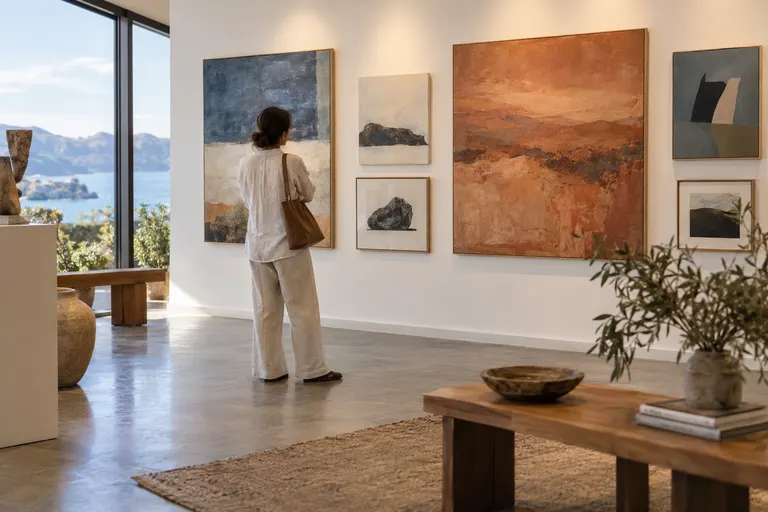
Ceramic art in Aotearoa New Zealand sits at a distinct intersection: it is at once a hands-on craft with ancient Pacific and Māori whakapapa, a material conversation in contemporary art, and a practical collecting category with its own rules. For a newcomer, the field can feel split between functional pots and gallery pedestals, between studio tradition and conceptual practice. The technical terms, markers of quality and value, and how ceramic works are shown and cared for all follow from the material itself.
Clay bodies: the material foundation
The term clay body refers to the specific mixture of clays and other minerals that forms the work. It is not the same as “clay” as a raw material. The mix determines the work’s colour, texture, and firing behaviour. In Aotearoa, studio potters and ceramic artists typically work with one of three broad bodies:
- Earthenware fires at lower temperatures (roughly 1,000-1,200 °C) and remains porous unless glazed. It is the most forgiving body for hand-building and is common in decorative and sculptural work.
- Stoneware fires between about 1,200-1,300 °C and becomes vitreous (non-porous) without glaze. It is the most common body for functional ware because it is durable and chip-resistant.
- Porcelain is a high-fired body (up to about 1,400 °C) that is white, dense, and translucent when thin. It is prized for fineness but is also the most fragile in the greenware stage.
A single artist may use several bodies across their career, so a change in body can help date a work.
Firing
- Bisque firing: the first firing hardens the clay into a porous state ready for glazing.
- Glaze firing: the second firing melts the glaze and fuses it to the body.
- Raku: a low-temperature process where pieces are removed while glowing and cooled rapidly; often leaves carbon patterns.
- Pit firing: an ancient, low-tech method using a hole in the ground; results are unpredictable and often smoky.
- Oxidation vs reduction: oxidation means plenty of oxygen in the kiln; reduction limits oxygen to change glaze colours and clay surfaces. The choice of atmosphere changes the final chemistry and look.
Glaze
Glaze is a glassy coating fused to the clay body by heat. It can be glossy, matte, textured, or coloured.
- Glaze fit: the glaze must expand and contract with the clay at the same rate. A mismatch causes crazing (fine cracks) or shivering (flaking).
- Lead and cadmium: old glazes may contain lead or cadmium. If a piece predates 1970 or is from an unknown studio, do not use it for food unless it has been professionally tested (Health and Safety guidelines, 2023).
- Food safety: a glaze is only food-safe if it is non-porous, lead-free, and has been fired to the correct temperature for the clay body. This is not always visible.
What affects value and condition
A work’s value rests on several factors that a buyer can check directly. None operates in isolation, but together they form a practical checklist.
Artist and provenance. A named artist with a documented exhibition history, gallery representation, or inclusion in public collections usually commands a higher price. Provenance means a record of ownership. Keep invoices, gallery receipts, and any correspondence that ties the work to the maker. For mid-century New Zealand studio pottery, a clear provenance can double the interest from serious collectors.
Condition. Examine the piece under good light, turning it slowly. Look for: - Cracks, chips, and hairlines (a fine crack that may not go through the body). - Crazing that has absorbed dirt or oil, which stains the network of fine lines. - Restorations: a repaired area may feel smoother or colder than the surrounding surface, or fluoresce differently under ultraviolet light. - Kiln scars, stilt marks, or grinding on the foot ring. Some are original to the making and acceptable; others indicate post-firing damage.
Rarity and period. A work from a short production run, an early career phase, or a specific firing technique (such as a particular anagama kiln loading) can be rarer than the artist’s typical output. Ask the seller whether the piece belongs to a known series or exhibition.
Scale and complexity. Larger works and those with multiple thrown or hand-built components, intricate glaze layering, or experimental firing carry higher technical risk and often higher value.
Functional vs sculptural. Functional ware (cups, bowls, teapots) is judged partly on how well it performs its job: balance, weight, pouring, handle comfort. Sculptural work is judged on formal qualities and conceptual intent. Decide which category the piece belongs to before you assess it, because the criteria differ.
How to approach collecting
Start by handling as many works as possible. Public collections with strong holdings include The Dowse Art Museum, Auckland War Memorial Museum, and the Sarjeant Gallery. Their study rooms let you examine pieces outside vitrines by appointment.
When you are ready to buy, work through this sequence:
- Set a focus. Pick a period, region, clay body, or firing type. A scattered collection is harder to insure, store, and sell later.
- Research the artist. Check the New Zealand Potters database, exhibition catalogues, and auction results from Webb’s or Dunbar Sloane.
- Ask the seller direct questions. Request the firing temperature, clay body, and glaze composition. If the seller cannot answer, factor that gap into your offer.
- Inspect in person. Photographs hide hairlines and glaze flaws. If you must buy remotely, ask for a condition report in writing and high-resolution images taken in raking light.
- Document everything. Record dimensions, signatures, impressed marks, and any paper labels. These small details anchor provenance later.
Display and care
Ceramic works need stable conditions. Place them away from direct sunlight, which fades glazes and can heat the body unevenly. Avoid narrow plinths in high-traffic areas. Secure tall or top-heavy pieces with museum wax or a custom mount.
Dust with a soft, dry brush or a microfibre cloth. Do not use water on porous bodies, unglazed surfaces, or pieces with unstable glaze fit. If a work needs a deeper clean, consult a ceramics conservator. Never use household cleaners, which can etch glazes or leave residues that attract dirt.
For storage, wrap each piece in acid-free tissue and place it in a rigid box. Do not stack wrapped works. If you must store multiple pieces on a shelf, leave enough space that no two can touch, and line the shelf with foam or felt.
Distinguishing functional ware from sculptural work
Ask three questions when the boundary is unclear:
- Did the maker intend the piece for use? Look for a food-safe glaze, a stable foot, and a form that suits a specific function (pouring, drinking, serving).
- Does the piece carry marks of use? A teapot with a glazed interior, a well-fitted lid, and a strainer hole at the spout base was built to brew tea.
- How does the artist or estate describe the work? Exhibition labels and catalogue entries often classify the piece explicitly.
A piece can sit in both camps, but the collecting criteria shift. A functional bowl with a sculptural gesture is still judged on its balance and rim comfort; a purely sculptural vessel is not.
Read next
-
Sculpture
Sculpture in Aotearoa New Zealand is not a single medium but a conversation about land, identity, and the body.
-
Painting
Painting in Aotearoa New Zealand is not a single market or a single style.
-
Works on paper
Works on paper is the quiet backbone of almost every serious art collection in Aotearoa New Zealand.
-
Fine-art prints
A fine-art print is not a poster, an inkjet copy of an oil painting, or a page torn from a book.
-
Photography
Photography in Aotearoa New Zealand occupies a distinctive place in the art market, one where the physical object is only part of the story.
-
Textile art
Textile art in Aotearoa New Zealand is a distinct field of contemporary practice that spans traditional Māori weaving, Pacific fibre work, and experimental fibre-based sculpture.