Painting
Painting in Aotearoa New Zealand is not a single market or a single style.
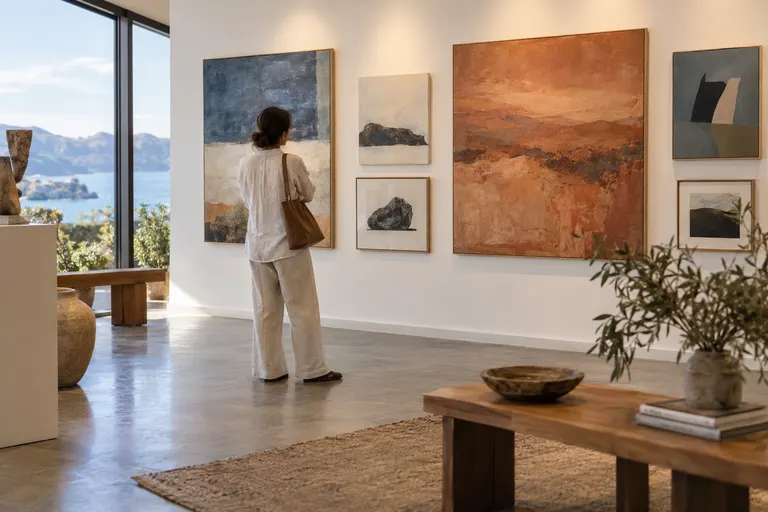
Painting in Aotearoa New Zealand is not a single market or a single style. It spans modernist landscapes, Māori and Pacific contemporary practice, and a small but interconnected commercial scene. For a collector or visitor, the practical question is not “what is painting?” but “what am I actually looking at, and how do I assess it fairly?”
The Landscape: Institutions and the Local Canon
The contemporary art ecosystem in Aotearoa is small and highly networked. The distinction between public and commercial spaces is blurring. The major institutional anchors are Te Papa Tongarewa in Wellington and Auckland Art Gallery Toi o Tāmaki in Auckland. These two collections define the historical canon against which contemporary painting is judged. Auckland Council owns Pah Homestead and its surrounding Monte Cecilia Park; the homestead housed the former Wallace Arts Centre, which was operated by the Wallace Arts Trust (a private trust, not a public body). The Trust’s current operations are separate from this guide; for its own records, contact the Trust directly.
Creative New Zealand, the national arts funding body, shapes which artists gain visibility through grants and strategic priorities. The result is a small, highly networked ecosystem where institutional recognition, iwi or community endorsement, and dealer representation matter more than any single market metric.
The most common newcomer error is to assume the market behaves like a smaller version of New York or London. It does not. The Aotearoa market is driven by a handful of institutions, a small pool of collectors, and a deep sensitivity to cultural provenance and relationship. Buying art here is as much about entering a community and respecting its protocols as it is about acquiring an object.
How to Look at a Painting: A Practical Method
Most writing about painting describes what a work means or where it sits in art history. That leaves a gap for someone standing in front of a canvas who wants to assess it directly. Use this sequence the next time you encounter a painting you are considering seriously, whether in a gallery, at an auction preview, or in an artist’s studio.
1. Start with Physical Facts, Not Interpretation
Before reading the wall label or asking for a price, work through these questions:
- What is the support? Canvas, linen, board, paper, or something else? Check the stretcher depth and whether the canvas is commercially primed or hand-sized.
- What is the medium? Oil, acrylic, enamel, watercolour, or a mix? Look for sheen differences, impasto, staining, or matte areas that suggest mixed media.
- How is it constructed? Look at the edges. Are there staples, tacks, or is the canvas wrapped cleanly? Check for a loose lining or a backboard.
- What is the scale? Step back and note how the work meets the wall. Does it command the space or sit quietly within it?
These observations ground you in the object before you absorb the story around it.
2. Assess the Surface
Move closer and examine the paint handling. Ask yourself:
- Is the paint applied with a brush, knife, spray, pour, or hand?
- Are the layers thin and translucent or thick and opaque?
- Can you see the ground through the paint in places, or is the surface completely covered?
- Is there a consistent facture across the whole work, or does the handling change in specific passages?
Look for pentimenti (visible revisions), drips that are integral to the composition, and areas where the artist has scraped back or reworked the surface. These are not flaws; they are evidence of decision-making.
3. Evaluate Colour and Tone
Colour is subjective, but you can assess it structurally. Check:
- Does the palette cohere around a limited set of pigments, or is it expansive?
- Are the colour relationships built on contrast, harmony, or dissonance?
- How does the work read from six metres away versus sixty centimetres? Some paintings resolve at distance; others reward close inspection and fall apart across a room.
- Look at the whites and the darks. Are they tinted, or are they straight from the tube? Muddy darks or chalky whites can signal uncertainty, though some artists use them deliberately.
4. Read the Composition
Composition is the skeleton. Identify:
- Where does your eye enter the painting, and where does it travel?
- Is there a dominant focal point, or does the work operate as an all-over field?
- How is the picture plane divided? Look for horizontal bands, vertical axes, diagonal thrusts, or a grid.
- What happens at the edges? Does the imagery continue beyond the frame, or is it contained?
For abstract work, the same questions apply, but the subject is the arrangement of forms, marks, and voids rather than recognisable objects.
5. Consider Condition
Condition affects value and longevity. Even if you are not a conservator, you can spot common issues:
- Is the paint film stable? Look for flaking, lifting, or cracking, especially in thick impasto areas.
- Is the canvas slack or dented? Check for ripples, corner draws, or stretcher-bar marks.
- Is there surface dirt, nicotine, or bloom on varnish? A dull or yellowed surface may clean up, but it may also hide problems.
- Are there repairs or patches visible from the back? If the back is covered, ask the seller to remove the backing board for inspection.
For works on paper, check for foxing, mat burn, and whether the sheet is fully adhered to a backing or hinged properly.
6. Contextualise the Work
Only now, after your own direct observation, bring in the contextual information. Read the label, talk to the gallerist, or research the artist. Useful questions at this stage:
- When was the work made, and where does it sit in the artist’s career? Early, breakthrough, mature, or late work?
- Has it been exhibited or published? Ask for exhibition history and catalogue references.
- What is the provenance? A clear chain of ownership from the artist to the current seller adds confidence.
- Is the work representative of the artist’s practice, or is it an outlier? Both can be valuable, but you should know which you are looking at.
Understanding the Market Segments
The Aotearoa painting market splits into several distinct segments. Each operates with different pricing, different buyer behaviour, and different risk profiles.
Primary Market: Buying from a Dealer Gallery
Dealer galleries represent living artists and sell new work directly from the studio. Prices are set by the gallery in consultation with the artist and tend to be consistent across a show. The gallery takes a commission (typically 40 to 50 percent). When you buy from a reputable dealer, you are paying for curation, advocacy, and a relationship that may give you access to better work over time.
Ask the gallery directly about the artist’s market: how many shows they have had, whether they have placed work in institutional collections, and what the secondary-market history looks like. A good gallerist will answer these questions openly.
Secondary Market: Auction and Resale
The secondary market in Aotearoa is small. The main auction houses handling fine art are Webb’s and Art+Object, both based in Auckland. Auction results are public, which makes them the most transparent price data available. Study past catalogues and results before bidding. Note that a single strong or weak result can skew an artist’s recorded market for years, because the sample size is so small.
Private resale also happens through dealers who occasionally handle work on consignment. These transactions are private, so prices are harder to verify. If you are offered a work on the secondary market, ask whether the artist’s primary dealer is aware of the sale. A work sold behind the dealer’s back can complicate future relationships.
Māori and Pacific Art
Māori and Pacific painting operates within its own cultural frameworks. Assessing these works requires more than formal analysis. You need to understand the artist’s iwi or community affiliations, the tikanga (protocols) that may attach to the imagery or materials, and whether the work was made for a specific kaupapa (purpose) or commission.
Some works incorporate taonga (treasured) materials or reference tūpuna (ancestors) directly. Ask the artist or seller about any cultural obligations that accompany the work. A painting may carry expectations about how it is displayed, who may handle it, or whether it can be on-sold. These are not restrictions on ownership; they are part of what the work is.
Institutional recognition matters here. Look for artists who have been included in major exhibitions such as the Walters Prize, the Auckland Art Gallery triennials, or exhibitions at The Dowse Art Museum, which holds one of the strongest public collections of Māori and Pacific contemporary art.
Building a Collection: Decision Rules
Rather than generic advice, use these specific decision rules when considering a purchase.
The “Three-Year” Test
If you are buying a work by a living artist, ask yourself whether you will still be engaged by it in three years. This is not about investment value. It is about whether the work has enough depth to sustain repeated looking. A painting that delivers everything on first encounter may have nothing left to give by the tenth viewing.
The Institutional Check
Before buying a work at a significant price, check whether the artist is held in any public collections. Te Papa, Auckland Art Gallery, Christchurch Art Gallery, and the Dowse are the key institutions. Public collection records are searchable online. An artist with no institutional presence is a higher-risk purchase, though not necessarily a bad one.
The Condition Threshold
Set a personal rule about condition. For contemporary work, expect excellent condition unless the artist’s practice deliberately incorporates deterioration. For historic work, decide what you can live with. A small area of stable cracking in a 1940s landscape may be acceptable; active flaking never is.
The Documentation Standard
For any purchase over a few thousand dollars, insist on a proper invoice that includes the artist’s name, title, date, medium, dimensions, edition if applicable, and a statement of provenance from the seller. If the work comes with exhibition history or publication references, get those in writing on the same document.
Display and Care: Core Principles
Paintings are vulnerable to light, humidity, heat, and poor handling. The damage is cumulative and often irreversible.
Light: Direct sunlight is the fastest way to fade pigments and embrittle canvas. Hang works on walls that never receive direct sun, or use UV-filtering glazing or films on windows. LED lighting is safer than halogen or fluorescent, but even LEDs emit some UV. Keep light levels moderate.
Humidity and temperature: Aim for a stable environment between 40 and 60 percent relative humidity and 18 to 24 degrees Celsius. Avoid hanging paintings on exterior walls without insulation, above radiators, or in bathrooms and kitchens. Fluctuations cause the canvas and ground to expand and contract, leading to cracking.
Handling and transport: Never carry a painting by the top of the frame or stretcher. Support it from underneath and at the sides. When transporting, protect the face with acid-free tissue or board, never bubble wrap directly against the paint surface. In a vehicle, keep the work upright and secured, not flat on a floor or seat.
Framing and glazing: For works on paper, use conservation-grade materials: acid-free mount board, UV-filtering glass or acrylic, and a sealed back. For canvas works, a simple floater frame or no frame at all is common in contemporary presentation, but ensure the hanging hardware is rated for the weight.
When to call a conservator: If you see active flaking, mould, a tear in the canvas, or a yellowed varnish that obscures the image, contact a qualified paintings conservator. Do not attempt to clean or repair a painting yourself. The New Zealand Conservators of Cultural Materials (NZCCM) maintains a register of accredited professionals.
The One Thing That Distinguishes Painting in Aotearoa
The single sentence that could not appear on a guide to painting in any other country is this: In Aotearoa New Zealand, a painting is never just an object; it is a node in a web of whakapapa, institutional relationships, and cultural obligations that a buyer enters into, not merely a market they transact in.
Read next
-
Works on paper
Works on paper is the quiet backbone of almost every serious art collection in Aotearoa New Zealand.
-
Fine-art prints
A fine-art print is not a poster, an inkjet copy of an oil painting, or a page torn from a book.
-
Photography
Photography in Aotearoa New Zealand occupies a distinctive place in the art market, one where the physical object is only part of the story.
-
Sculpture
Sculpture in Aotearoa New Zealand is not a single medium but a conversation about land, identity, and the body.
-
Ceramic art
Ceramic art in Aotearoa New Zealand sits at a distinct intersection: it is at once a hands-on craft with ancient Pacific and Māori whakapapa, a material conversation in contemporary art…
-
Textile art
Textile art in Aotearoa New Zealand is a distinct field of contemporary practice that spans traditional Māori weaving, Pacific fibre work, and experimental fibre-based sculpture.