Photography
Photography in Aotearoa New Zealand occupies a distinctive place in the art market, one where the physical object is only part of the story.
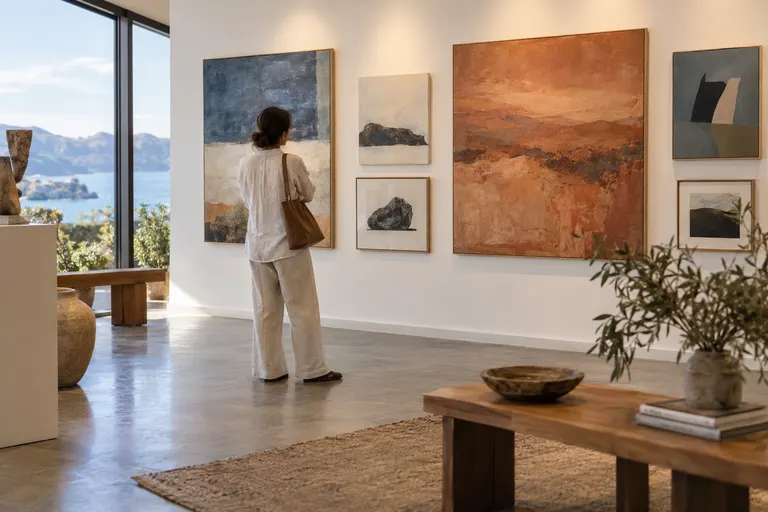
Photography in Aotearoa New Zealand occupies a distinctive place in the art market, one where the physical object is only part of the story. Unlike a painting or sculpture, a photograph is almost always a multiple, and its value depends on a chain of decisions made by the artist, the printer, the publisher, and the gallery. Understanding that chain is the difference between buying a picture and buying a work of art.
The Print Process
Most contemporary photographs sold through New Zealand dealer galleries are not unique objects. They are produced in limited runs, typically of 3 to 15, plus artist’s proofs. The run size is set by the artist before the work is offered, and it is recorded in the gallery’s paperwork and the artist’s catalogue raisonné where one exists. The print itself is usually made on archival pigment paper, often branded as “giclee”, or on traditional silver-gelatin paper for analogue work. Pigment prints are standard for digital work because the inks are rated to resist fading for decades under normal display conditions; silver-gelatin prints have a longer track record but require more careful handling.
The limited run is the core of the print market. A work described as “edition of 10” means exactly ten prints exist, plus possibly a small number of artist’s proofs (APs) and printer’s proofs (PPs). Ask the artist or the gallery to state the total run size in writing before purchase. In Aotearoa New Zealand, most reputable dealers follow the artist’s protocol for limited runs, but there is no legal requirement for it; the integrity of the run depends on the artist and gallery, not on statute.
What to Check Before You Buy a Print
- Confirm the total number of prints in the run, the number of artist’s proofs, and the number of printer’s proofs. Get this in writing.
- Check the print for a signature, date, and any notation such as “AP” or “HC”. A print marked “AP” (artist’s proof) or “HC” (hors commerce) is not part of the numbered run and may be valued differently.
- Ask which paper was used and how the print was mounted. Archival pigment paper and silver-gelatin paper carry different handling and longevity profiles.
- Request the original invoice, any certificate of authenticity, gallery records, and relevant exhibition catalogues. The artist’s file, gallery records, and a written receipt are the backbone of provenance; a work without documentation is a work without a history.
- For photographic prints, the negative or digital file is the master. The print’s number within the run, the total run size, and the printer’s notation are the primary evidence.
Provenance for Unique Works
For unique works such as paintings or sculptures, provenance is the equivalent of a limited run: the documented chain of ownership from the artist to the current holder. A clean line back to the artist or a major collection is worth more than any aesthetic quality. The key documents are the original invoice, any certificate of authenticity, gallery records, and exhibition catalogues. Institutional records at Te Papa Tongarewa and Auckland Art Gallery Toi o Tāmaki are the gold standard.
Display and Care
Fading is a real risk. Most galleries in Aotearoa will not guarantee colour permanence beyond the manufacturer’s lightfastness rating, and any replacement policy is a contractual matter between buyer and seller, not a legal right. Take these steps to protect the work:
- Frame with UV-protective glass.
- Keep works out of direct sunlight.
- Use a specialist framer who understands the difference between archival and decorative mounting.
Next Steps
For buying, see the Buying art well guide. For display, see Display and care. For first steps, see Choosing art for your space. For price and valuation questions, see the market page.
SPECIAL NOTE: The former Wallace Arts Centre at Pah Homestead is a distinct entity from the James Wallace Arts Trust. This publication is not affiliated with the former TSB Bank Wallace Arts Centre or the James Wallace Arts Trust.
Read next
-
Fine-art prints
A fine-art print is not a poster, an inkjet copy of an oil painting, or a page torn from a book.
-
Painting
Painting in Aotearoa New Zealand is not a single market or a single style.
-
Works on paper
Works on paper is the quiet backbone of almost every serious art collection in Aotearoa New Zealand.
-
Sculpture
Sculpture in Aotearoa New Zealand is not a single medium but a conversation about land, identity, and the body.
-
Ceramic art
Ceramic art in Aotearoa New Zealand sits at a distinct intersection: it is at once a hands-on craft with ancient Pacific and Māori whakapapa, a material conversation in contemporary art…
-
Textile art
Textile art in Aotearoa New Zealand is a distinct field of contemporary practice that spans traditional Māori weaving, Pacific fibre work, and experimental fibre-based sculpture.