Art forms and collecting guides
When you walk into a dealer space or public institution in Aotearoa, the work in front of you is rarely just an object.
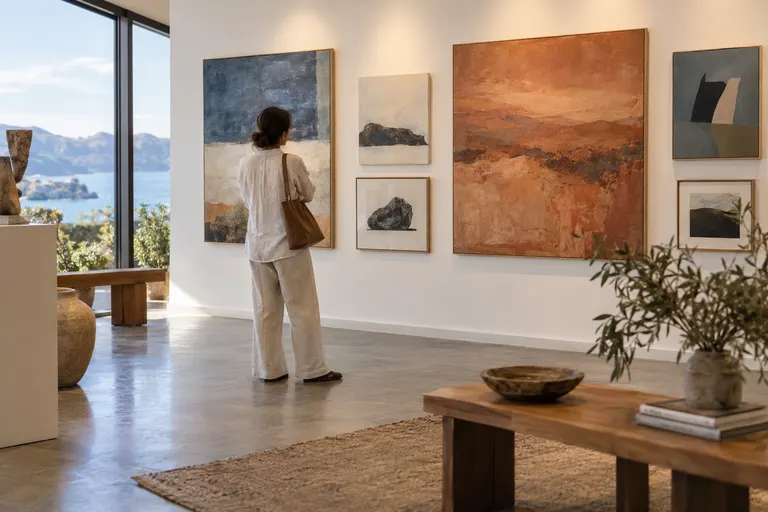
When you walk into a dealer space or public institution in Aotearoa, the work in front of you is rarely just an object. It carries a history of relationships, with the maker, with the community that shaped them, with the institutions that validated them, and with the land and genealogies they draw on. For a first-time buyer, that can feel like a lot to decode. For an experienced collector, the same context is the difference between a considered purchase and a costly mistake.
The Aotearoa Art Guide helps you browse the art forms covered across this site, check what matters before you buy, and understand where cultural context carries the most weight. Use the directory below as your map; use the sections that follow as your method.
How the directory is organised
The directory is grouped by medium and by the questions that medium raises. You will not find a single “best” list, because no objective ranking works across a small, relationship-driven market. Each section compares works on the attributes that actually matter when you are standing in front of an object and deciding to engage with it seriously.
The browsing logic is simple. Start with the maker’s name and career stage, then move to the work’s chain of ownership and exhibition history, then to its physical condition, and finally to the cultural context that surrounds it. That order mirrors the sequence a serious buyer or curator would follow, and it prevents the common mistake of falling in love with a work’s look before checking that it is genuine, documented, and culturally appropriate to own.
The Aotearoa art ecosystem in brief
Contemporary art in Aotearoa New Zealand is a small, highly networked ecosystem. Māori and Pasifika perspectives are not a niche within this scene; they are the central conversation. The distinction between dealer and exhibition venue is blurring, and the market behaves differently from a smaller version of New York or London. Newcomers often assume the market works like an international auction house, but buying here is driven by a handful of institutions, a tiny pool of collectors, and a deep sensitivity to cultural lineage and relationship. The honest version is that buying art in Aotearoa is as much about entering a community and respecting its protocols as it is about acquiring an object.
The key institutions that set the benchmark are Auckland Art Gallery Toi o Tāmaki and Te Papa Tongarewa. Creative New Zealand shapes which artists and projects gain visibility through its grants and strategic priorities. The former Wallace Arts Centre at Pah Homestead was a significant venue for contemporary art in Aotearoa, but this publication is not the former TSB Bank Wallace Arts Centre or James Wallace Arts Trust, and it does not speak for them.
What to check before you buy
Provenance
A clean, documented chain of ownership back to the maker or a major collection is the single strongest signal of authenticity and long-term relevance. Ask the dealer for a written provenance statement, even for contemporary works. If the chain has gaps, ask why; a gap may be innocent (a private sale between friends) or a red flag. For Māori and Pacific works, the ownership record also carries cultural weight: a work that has passed through a marae, a church, or a family collection may carry obligations or restrictions that a written record will not show. A clean line back to the maker or a major collection is worth more than any aesthetic quality.
Exhibition history
The number and prestige of institutional shows an artist has had. A single major biennale can outweigh dozens of local shows. Check the artist’s CV for solo exhibitions at Te Papa Tongarewa, Auckland Art Gallery Toi o Tāmaki, or a major international venue. Institutional representation is a strong signal of long-term relevance.
Cultural authority
For Māori and Pasifika artists, the degree to which the maker is recognised by iwi or community leaders as a legitimate voice can be more important than academic credentials. A buyer cannot verify this from a CV alone; it requires listening to the maker’s own statements, reading curatorial texts, and understanding the tikanga (protocols) that surround the work. A work that ignores or disrespects these protocols may be withdrawn from display even if it is technically accomplished.
Medium rarity
How uncommon the material or technique is within the maker’s own body of work. A unique piece in a signature medium (for example, a Hotere painting on black) is often more valuable than a rare experiment in an unfamiliar material. The maker’s own catalogue raisonné, when it exists, is the most reliable reference; if one does not, the dealer’s records and the studio notes are the next best source.
Condition
The physical state of the work, graded from pristine to damaged. For paintings, check for craquelure, flaking, or discoloured varnish. For works on paper, look for foxing, acid burn, or fading. For sculpture, check for chips, cracks, or repairs. Even minor restoration can halve value for serious collectors, so always request a condition report from the seller. If a work is damaged, do not assume it is worthless; a major piece by a significant artist with a clean ownership record can still be collectable, but the price must reflect the condition.
Scale
Physical dimensions of the work; larger is not always better, because big works are harder to place and may be less liquid. A two-metre canvas can be a centrepiece, but it can also be a liability in a rental apartment. Conversely, small works on paper are easier to store and resell, but they rarely command the same attention.
Market liquidity
How quickly a work can be resold; higher is better, but the market is so thin that even major names can take months to sell. Auction results from the major houses are sporadic, and private sales are common but unrecorded.
Institutional representation
Whether the artist is in the collection of Te Papa Tongarewa or Auckland Art Gallery Toi o Tāmaki; this is a strong signal of long-term relevance.
Critical reception
The volume and tone of published reviews and scholarly writing; a single hostile review in a major journal can be more damaging than many positive ones.
Cultural sensitivity
The degree to which the work and its display respect Māori or Pasifika protocols (tikanga); this can determine whether a work is even shown publicly.
Artist career stage
Whether the maker is emerging, mid-career, or established; early-career work can be more experimental and later work more refined, so “higher” is not necessarily better.
Affordable entry points
- Prints and editions: Limited-edition prints by established names, typically priced from a few hundred to several thousand dollars; a practical entry point for first-time buyers.
- Works on paper: Drawings, watercolours, and photographs, often priced lower than paintings by the same artist.
- Small works: Small-scale paintings or sculptures, often shown in a “back room” or “project space” of a dealer.
- Artist proofs and monoprints: Unique or near-unique impressions that sit between prints and paintings.
- Emerging artist works: Pieces by artists early in their career, often priced at a fraction of their later market value.
- Online auctions: A growing secondary channel, but requiring extra ownership checks.
- Art fairs: The Auckland Art Fair and other events where dealers present curated booths; useful for surveying but not for bargains.
- Charity auctions: A risky but occasionally rewarding source, where works are donated and sold without reserve.
- Student shows: A low-cost entry point, but with no guarantee of future value or institutional validation.
Practical advice
- Look for the artist’s exhibition history, not just the CV.
- Ask for a written invoice that names the artist, title, date, medium, and any edition details.
- Request a condition report and check whether the dealer offers a certificate of authenticity.
- For prints and photographs, verify the edition size and that the work is signed and numbered.
- For Māori and Pacific works, ask the dealer about the maker’s iwi or island heritage and any cultural protocols (tikanga) that affect display or handling.
- Do not assume that a high price equals high quality; in the NZ market, a modestly priced work by a mid-career artist with strong institutional support is often a safer long-term buy than a flashy canvas by an unknown name.
- Check if the artist is represented by a dealer; if so, that dealer is the primary source for ownership records and condition.
- Look for the artist’s name in the collection lists of Te Papa or Auckland Art Gallery; institutional representation signals long-term relevance.
- Ask the dealer for a written invoice that includes the artist’s name, title, date, medium, dimensions, and any edition details; this is the minimum documentation you need.
- For works with cultural significance, ask whether the maker or their iwi has approved the display and whether any restrictions apply.
- If a price seems too good to be true, it usually is; in the thin NZ market, a bargain is more often a red flag than an opportunity.
- When buying from a private seller, request a copy of the original invoice or dealer receipt; if the seller cannot provide one, treat the ownership record with suspicion.
Understand how medium changes selection, display, documentation and care.
Art forms and collecting guides
Two-dimensional art
Editions
Three-dimensional art
Material-led art
Time-based and digital art
Aotearoa contexts
Read next
-
Painting
Painting in Aotearoa New Zealand is not a single market or a single style.
-
Works on paper
Works on paper is the quiet backbone of almost every serious art collection in Aotearoa New Zealand.
-
Fine-art prints
A fine-art print is not a poster, an inkjet copy of an oil painting, or a page torn from a book.
-
Photography
Photography in Aotearoa New Zealand occupies a distinctive place in the art market, one where the physical object is only part of the story.
-
Sculpture
Sculpture in Aotearoa New Zealand is not a single medium but a conversation about land, identity, and the body.
-
Ceramic art
Ceramic art in Aotearoa New Zealand sits at a distinct intersection: it is at once a hands-on craft with ancient Pacific and Māori whakapapa, a material conversation in contemporary art…