Works on paper
Works on paper is the quiet backbone of almost every serious art collection in Aotearoa New Zealand.
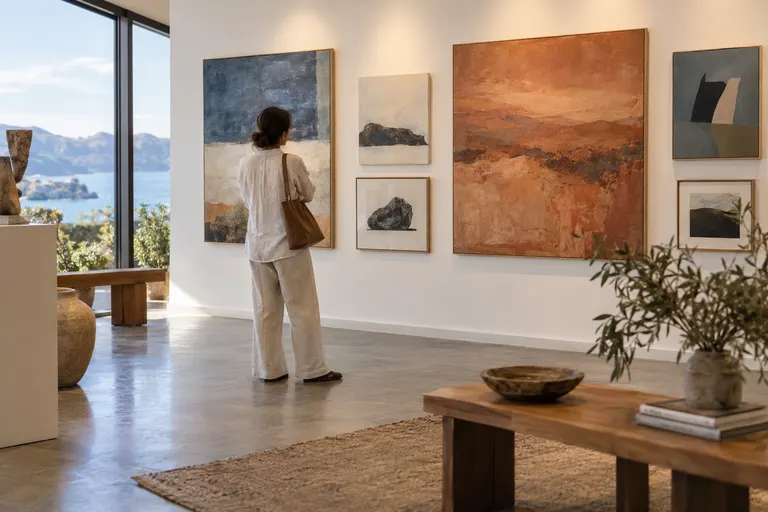
Works on paper is the quiet backbone of almost every serious art collection in Aotearoa New Zealand. Drawings, watercolours, pastels, and mixed-media pieces on paper are often the most intimate works an artist makes, the place where ideas are tested before they reach canvas or sculpture. They are also, for new and established collectors alike, the most approachable entry point into a market that can otherwise feel intimidating.
What follows answers that entry directly: what works on paper actually are, why they are collected, and how to buy, store and display them well in the Aotearoa context. It does not cover prints or editioned multiples in depth, nor the broader question of how to choose art for your space.
What counts as a work on paper
In collecting and museum language, “works on paper” is the catch-all category for drawings, watercolours, pastels, prints, collages, photographs, and any mixed-media piece whose primary support is paper. The label is a curatorial convenience: it groups objects that share similar physical vulnerabilities and similar display needs, regardless of style or era. A work on paper is any original artwork whose primary support is paper. The category includes drawings in graphite, charcoal, pastel, ink or gouache; watercolours; and mixed-media pieces where paper is the base. It also includes works that combine paper with collage, photomontage, or layered digital and hand-applied marks.
In Aotearoa New Zealand, the category overlaps with Māori art and Pacific art in ways that matter for care and display. Many contemporary Māori and Pasifika artists use paper as a surface for drawing, printmaking, and mixed media. When you encounter a work on paper by a Māori or Pacific artist, the same technical rules apply as for any paper work, but the cultural context is part of the object. Correct attribution, iwi or island-nation connection, and the artist’s own stated intentions are not optional metadata; they are central to the work’s meaning. The Art Galleries and Museums Association of New Zealand’s 2021 guidelines on care of cultural material note that handling and display decisions for taonga and culturally significant works should be made in consultation with the community of origin (Aotearoa Art Guide, 2024). In Aotearoa New Zealand, the category includes everything from early colonial watercolours to contemporary Māori and Pacific works on paper, and the care principles are the same even when the cultural context differs.
Why paper needs different care than canvas or panel
Paper is hygroscopic: it absorbs and releases moisture with the surrounding air, and it expands and contracts at a different rate than the paint or ink on its surface. The result is that a work on paper is more sensitive to humidity changes than a canvas painting. The paper itself can cockle, buckle, or develop foxing (brown spots caused by mould or metal impurities). The media, watercolour, gouache, pastel, ink, can bloom, fade, or lift if the paper moves under it. The single most important rule is to keep the work in a stable environment. The National Gallery of Australia’s conservation guidance (2021) recommends a relative humidity of 45-55% and a temperature of 18-21°C for paper-based works, and warns that fluctuations are more damaging than a steady slightly imperfect level. The Canadian Conservation Institute (CCI) notes the safe relative humidity range for paper is 40-55%, with a preferred 50% at 18-22°C, and that fluctuations are more damaging than a steady slightly-off value (CCI, 2023). Avoid hanging works on exterior walls, above heaters, or in rooms with fireplaces or uncurtained windows that receive direct sun.
The most common damage is not tears but cockling (waviness) and foxing.
Paper quality
Rag paper (cotton or linen) is more stable and alkaline-buffered; wood-pulp paper from before the mid-20th century is often acidic and brittle. The National Gallery of Art (Washington) states that “acidic paper is inherently unstable” and recommends matting and backing with alkaline buffered boards.
Hot-pressed (smooth), cold-pressed (medium), and rough surfaces affect how watercolour and graphite sit; there is no “better” grade, only the artist’s intent and the work’s needs.
Hinging and mounting
Hinging is the standard way to attach a work to a backing board. Use archival hinge materials such as Japanese tissue and wheat-starch paste; pressure-sensitive tapes are not archival and can stain or weaken the sheet over time.
The work should never be glued or dry-mounted directly to a board unless the artist or a conservator has done so as part of the original construction.
If you are unsure, a paper conservator should carry out any hinge or mount. The American Institute for Conservation (AIC) publishes a find-a-conservator directory; in Aotearoa, the New Zealand Conservators of Cultural Materials (NZCCM) maintains a similar list (as of 2025).
Glazing
Use UV-filtering glass or acrylic (often called “conservation glazing”) to reduce light damage; standard glass blocks little UV.
For pastel or chalk works, do not use acrylic glazing that creates static, which can lift loose pigment; use glass or specify anti-static acrylic (source: Preservation Australia, 2023).
Keep the glazing from touching the artwork surface; use a mat or spacer, never rest glass directly on the image.
For works with heavy media or collage, consider a deeper frame with a spacer or “float” mount so the paper is not pressed.
How to buy works on paper in Aotearoa
Buying a work on paper rewards patience and close looking. Unlike a painting on canvas, where the surface is varnished and relatively uniform, a work on paper often shows the artist’s hand directly. That means condition matters more than in almost any other medium. Before you buy, inspect the work under good light. Look for foxing, cockling, fading, or tide lines from water damage. Ask the dealer or auction house whether the work has been lined (backed with another sheet), cleaned, or trimmed, and whether the current frame uses archival materials. If the answer is unclear, factor the cost of a conservator’s assessment into your budget.
Where to look
Commercial galleries with a focus on works on paper operate in Auckland, Wellington, Christchurch, and Dunedin. Some dealer galleries specialise in historical New Zealand works on paper, while others represent living artists who work primarily in drawing and watercolour. Auction houses, including Webb’s and Art+Object, hold dedicated works-on-paper sales several times a year. Public gallery shops, such as those at Auckland Art Gallery Toi o Tāmaki and Christchurch Art Gallery Te Puna o Waiwhetū, often stock unframed works on paper by emerging and mid-career artists at accessible prices. Artist-run spaces and open-studio events can also be good places to buy directly.
Questions to ask before you commit
Ask whether the paper is the artist’s original support or a secondary support. Some works are conceived on one surface and later transferred; knowing which you are buying changes how you understand the piece. Ask about the media: a gouache work needs different framing than a graphite drawing, and a pastel needs different glazing than an ink wash. Ask whether the work was stored flat or rolled. Rolled works can be flattened by a conservator, but the process takes time and may not remove all memory of the curl.
Storing and displaying works on paper
A work on paper is never “finished” once it leaves the framer. Its long-term survival depends on how you store and display it. The two biggest enemies are light and moisture, and they often work together.
Light
All light fades paper and media, but ultraviolet light does the most damage in the shortest time. Even indoor lighting adds up. Rotate works on display. If you cannot rotate, use UV-filtering glazing and keep the work out of direct sun. LED lighting produces less UV than halogen or fluorescent, but it still emits visible light that cumulatively fades pigments. The rule of thumb: if you can see the work, light is changing it.
Humidity and temperature
The stable environment recommended by the National Gallery of Australia and the CCI applies as much to storage as to display. A wardrobe or internal closet is often better than a garage or attic. If you store unframed works, use acid-free folders or boxes and interleave with acid-free tissue. Keep storage flat, not rolled, whenever possible. For framed works, stand them vertically on padded shelves; never stack framed works face-to-face without a rigid barrier between them.
Handling
Handle works on paper as little as possible, and when you must, use clean, dry hands or, better, nitrile or cotton gloves. Support the sheet fully from beneath; never lift a sheet of paper by one corner or edge. If a work is unframed and you need to move it, use a rigid support board larger than the sheet and carry it flat.
Framing in the New Zealand climate
New Zealand’s climate, coastal, humid, and changeable, punishes paper faster than a dry inland climate does. A frame that works in Melbourne or London may not work in Auckland or Wellington. The key is to think of the frame as a sealed environment, not just a border.
Choosing a framer
Not all framers understand archival practice. Ask a framer directly: “Do you use reversible hinging with Japanese tissue and wheat-starch paste?” and “Do you cut the window mat from cotton rag or alpha-cellulose board?” If they hesitate, find another framer. The New Zealand Conservators of Cultural Materials (NZCCM) can point you to conservator-grade framers.
The frame package
A proper frame package for a work on paper contains, from front to back: the glazing (UV-filtering glass or acrylic), a window mat (cut from archival board), the artwork (hinged to the back mat or backing board with archival hinges), a backing board (archival, rigid), and a dust seal (tape or paper over the back of the frame to slow air exchange). For pastels or charcoals, a spacer or deeper rebate keeps the glazing off the surface. For works on paper with significant cultural meaning, consult the artist or community about appropriate presentation; some works should not be enclosed behind glazing in ways that separate them from viewers.
Insurance and documentation
Insure works on paper under a specific rider on your contents policy or through a specialist art insurer. Standard contents policies often cap payouts for individual artworks. Keep a file for each work that includes the purchase receipt, a condition report (dated photographs of the front and back, plus close-ups of any existing damage), the artist’s name, title, date, media, dimensions, and any provenance or exhibition history you have. Update the condition photographs every few years. If you lend a work, photograph it before it leaves and after it returns.
When to call a conservator
A paper conservator is not only for disasters. Call one if you see new foxing, blooming (a white or grey haze on the surface), flaking media, or a musty smell that suggests mould. Call one before you frame a newly acquired work that arrives in an old or unknown frame. Call one if a work gets wet, even if it looks fine after drying. Mould can start within 48 hours in New Zealand’s humidity. The NZCCM directory lists qualified paper conservators in Aotearoa.
Read next
-
Painting
Painting in Aotearoa New Zealand is not a single market or a single style.
-
Fine-art prints
A fine-art print is not a poster, an inkjet copy of an oil painting, or a page torn from a book.
-
Photography
Photography in Aotearoa New Zealand occupies a distinctive place in the art market, one where the physical object is only part of the story.
-
Sculpture
Sculpture in Aotearoa New Zealand is not a single medium but a conversation about land, identity, and the body.
-
Ceramic art
Ceramic art in Aotearoa New Zealand sits at a distinct intersection: it is at once a hands-on craft with ancient Pacific and Māori whakapapa, a material conversation in contemporary art…
-
Textile art
Textile art in Aotearoa New Zealand is a distinct field of contemporary practice that spans traditional Māori weaving, Pacific fibre work, and experimental fibre-based sculpture.