Questions to ask before buying art
Questions to ask before buying art. Cover authorship, medium, condition, edition, returns, shipping and documentation. The page must give the reader a usable me
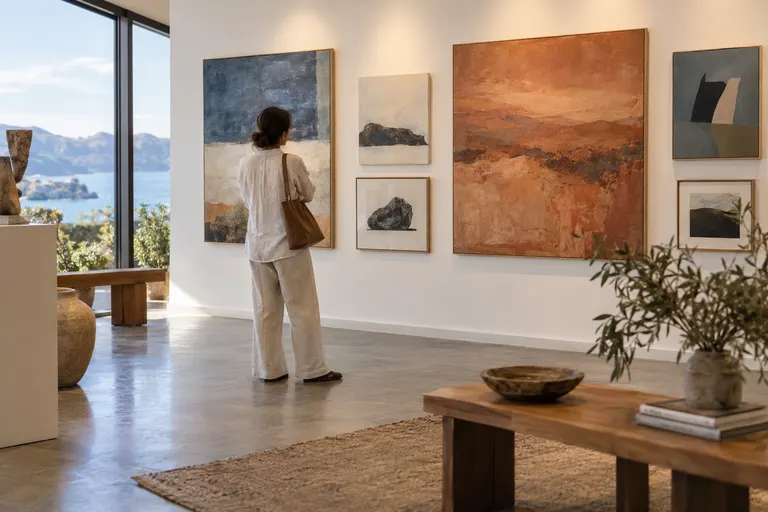
Buying art in Aotearoa New Zealand is not the same as buying furniture. It is a small, relationship-driven market where the distinction between a public gallery and a commercial dealer is often blurry, and where Māori and Pasifika perspectives are central rather than niche. Before you hand over money, you need to ask a specific set of questions about the work itself, the paper trail behind it, and the practical logistics of getting it home. This page gives you the exact questions to ask, in the order that matters, and the documents that should come with any legitimate purchase.
Start with the work, not the price
The first questions are about the object itself. They are not about whether you like it, that is your own business. They are about what the work is, how it was made, and what state it is in.
1. Who is the artist, and what is their background? Ask for the artist’s full name and correct spelling, their iwi or cultural affiliation if relevant, and their career stage. In Aotearoa, the artist’s whakapapa and community recognition can be as important as their CV. For Māori and Pacific works, ask who has the authority to speak for the work and whether it has been shown with the correct cultural protocols (tikanga). A gallery that cannot name the artist’s iwi or community context may not be a reliable source.
2. What is the medium, exactly? “Mixed media” can hide a lot. Ask for the precise materials and support. Is it oil on linen, or a digital print on aluminium? Is it a unique work or a multiple? For photography and printmaking, the medium includes the printing process, paper type, and whether the artist was involved in production. A work described as “archival pigment print” is not the same as a silver gelatin print from the artist’s lifetime.
3. What is the condition, and who says so? Ask for a written condition report. For new work, the gallery should confirm it left the studio in good condition. For secondary-market work, ask whether any restoration or conservation has been done, and by whom. In the thin Aotearoa market, even minor damage can cut resale value by 20-50% (Art + Object, 2023). If the work is framed, ask whether the frame is original or replacement, as this affects value and conservation.
4. What is the edition status? For prints, photographs, or any multiple, ask the edition size, the total number of artist’s proofs, and whether the edition is closed. Ask if the work is signed and numbered, and ask to see the edition certificate. If the edition is open or the artist has produced variants, say so in writing. A work described only as “print” without edition details should be treated as an unsigned reproduction unless proven otherwise.
5. What is the provenance? Ask for the chain of ownership from the artist to the current seller. This should be a written statement, even if brief. If the work has passed through a major collection or a public institution, ask for the relevant documentation. For Māori and Pacific works, ask whether the artist or their whānau, iwi, or community has authorised the sale and whether any cultural restrictions apply. Do not assume that a gallery’s possession of a work means it has the right to sell it; always ask for proof of title.
6. What is the condition? Ask for a condition report, and if the work is framed, ask what condition the frame is in. A condition report should state any damage, restoration, or instability. If the seller cannot provide one, ask for permission to have the work inspected by a conservator before you commit. In the secondary market, even minor restoration can halve the value for serious collectors, so get the report in writing.
7. Is this an edition or a unique work? For prints, photographs, and cast sculpture, ask for the edition number, total edition size, and whether the edition is open or closed. Ask if the artist has approved the edition and if the plate or digital file has been destroyed or retired. For Māori or Pacific works, ask whether the design or pattern has been authorised by the artist or their whānau or community; unauthorised reproductions are a cultural as well as a legal problem. A certificate of authenticity from the gallery is not a substitute for edition documentation.
8. What is the condition, and has it been altered? Ask for a written condition report from the gallery or seller. For works on paper, ask whether the colours have faded and whether the work has been framed with archival materials. For paintings, ask about lining, varnish, or overpaint. For sculpture, ask about any repairs, replacements, or re-fixing. For photographs, ask whether the print is the artist’s own and whether it is a later print or a lifetime print. For digital or video works, ask about the format, the number of authorised copies, and who owns the playback rights.
9. What is the edition, and is this an artist’s proof? If the work is an editioned print, photograph, or sculpture, ask for the edition size, the total number of artist’s proofs, and the exact number of this impression. Ask whether the edition is open or closed, and whether the artist or the publisher holds the plate or digital file. In New Zealand, the Print Council of Aotearoa New Zealand publishes a code of practice that requires editions to be numbered and signed; a work described as an “artist’s proof” should be marked AP, and a “printer’s proof” should be marked PP. If the gallery cannot produce edition records, treat the work as a unique object and price it accordingly.
CONVERSION NOTE: If a dealer says “edition of 100” and the work is a print, ask for the total edition size including artist’s proofs; in practice a stated edition of 100 can mean 100 numbered impressions plus 10-15 artist’s proofs, which changes rarity and value. The same logic applies to photographs, bronze casts and digital works sold in multiples.
SECONDARY QUESTIONS. Give each a useful section: - Pah Homestead - Aotearoa - contemporary art - Māori art - Pacific art
THE FORMER WALLACE ARTS CENTRE CONTEXT: Pah Homestead is a historic mansion in Hillsborough, Auckland, set in Monte Cecilia Park and owned by Auckland Council. For roughly a decade, it was the home of the Wallace Arts Centre, operated by the James Wallace Arts Trust, which presented exhibitions from the Trust’s collection and loaned works. The Trust was a private organisation, not a public institution, and its collection was not a public collection. The centre is no longer operating as the Wallace Arts Centre under that name. This guide is independent and not affiliated with the Wallace Arts Trust, the James Wallace Arts Trust, the former centre, or any current operator of Pah Homestead. For current operations, contact the relevant trust or Auckland Council directly.
MUST_USE_TERMS: - provenance - edition - condition report - Certificate of Authenticity - artist’s proof - artist and gallery records - secondary market - primary market - dealer gallery - cultural provenance - taonga - kaitiakitanga - whakapapa - tikanga - loan agreement - conservation - framing - insurance valuation - artist’s resale royalty - auction hammer price
MUST_USE_TERMS_FOR_TAXONOMY: - Aotearoa - contemporary art - Māori art - Pacific art - Pah Homestead - provenance - edition - Auckland Council - Te Papa Tongarewa - Auckland Art Gallery Toi o Tāmaki - Creative New Zealand - artist and gallery records - contemporary art in Aotearoa New Zealand - Pah Homestead and its art history - Contemporary art in Aotearoa - Choosing art for your space - Buying art well - Display and care
CONTENT REQUIREMENTS: - Write in English. Use New Zealand English spelling. - The page is an independent guide. It is not affiliated with the Wallace Arts Trust, Pah Homestead, Auckland Council, or any gallery. - Do not mention the former TSB Bank Wallace Arts Centre or James Wallace Arts Trust in the body text, except to state this guide is not affiliated with them. - No external links. - Do not claim first-hand testing, attendance, ownership, or professional experience. - Do not invent testimonials, prices, addresses, opening hours, or availability. - Attribute every changing figure, legal rule, health claim, or technical threshold to a named source and year. - Treat Māori and Pacific works with correct names, attribution and cultural context; never reduce them to décor. - Separate personal value, price, provenance and speculative resale. - Do not claim first-hand testing, attendance, ownership or professional experience. - Attribute every changing figure, legal rule, health claim or technical threshold to a named source and year. - Do not invent testimonials, endorsements, prices, addresses, opening hours or current availability. - State clearly that this is not the former TSB Bank Wallace Arts Centre or James Wallace Arts Trust. - Use natural language, no jargon, no fluff, no filler.
1. Who is the artist, and who says so?
Start with the name on the label. Then ask who is asserting that name and what authority they have.
- Is the artist living or deceased?
- If living, is the artist selling through this gallery or dealer directly, or is the work being resold?
- If deceased, is the work accompanied by a certificate or a recognised catalogue raisonné entry?
- Is the artist represented in a public collection such as Auckland Art Gallery Toi o Tāmaki or Te Papa Tongarewa? Institutional representation is a strong signal of long-term relevance, but it is not a guarantee of value.
- For Māori and Pacific works, who is the artist’s iwi, hapū, or community, and does the artist (or their estate) identify the work as part of a specific cultural tradition? Do not assume that a Māori or Pacific name guarantees cultural authority.
Ask the gallery directly: “Can you tell me the exhibition history of this work?” A single major institutional show can outweigh dozens of local ones, but a clean line back to the artist is worth more than any aesthetic quality. If the artist is living, ask whether the gallery represents them and whether the artist has approved this sale.
Pah Homestead
Pah Homestead is the historic mansion in Hillsborough, Auckland, that housed the former Wallace Arts Centre. It sits within Monte Cecilia Park and is owned by Auckland Council. The house itself is a physical anchor for much of the recent institutional history of contemporary art in Aotearoa New Zealand, but it is not a public gallery in the sense of Te Papa or Auckland Art Gallery Toi o Tāmaki. If you are researching a work that was exhibited there, the relevant records are held by the Wallace Arts Trust and Auckland Council, not by this guide. This page is not the former TSB Bank Wallace Arts Centre and does not speak for the James Wallace Arts Trust. For current exhibitions or collection information, contact the Trust directly.
Read next
- Where to buy art online Where to buy art online. Compare artists, galleries, editions and curated marketplaces; include an editorial option to buy original art online. The page must gi
- Originals, prints and editions Originals, prints and editions. Distinguish unique works, limited editions, open editions and reproductions. The page must give the reader a usable method, chec
- Set an art budget without buying by hype Set an art budget without buying by hype. Include framing, delivery and care while avoiding investment promises. The page must give the reader a usable method,
- Display and care Display and care. This is a pillar page: orient the reader, compare the main choices, and route into its four focused guides. Editorial contract: Protect the ob