Māori art
Māori art is the foundational visual culture of Aotearoa New Zealand, a living tradition that spans carving, weaving, painting and work in video, sculpture and installation.
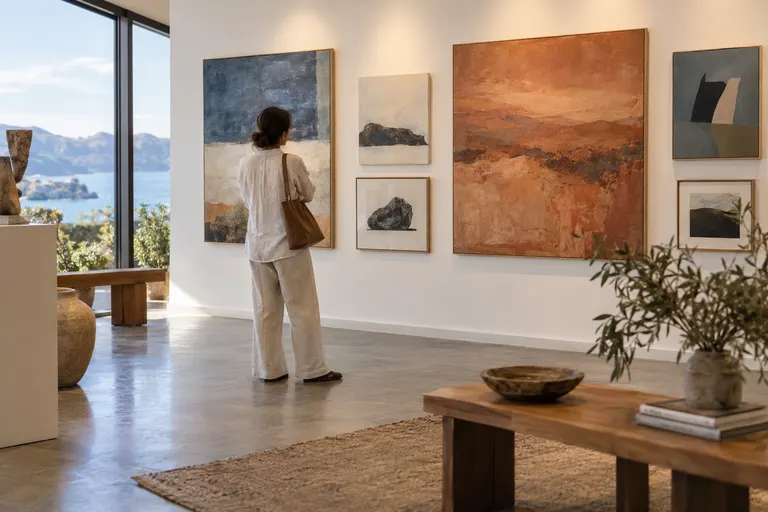
Māori art is the foundational visual culture of Aotearoa New Zealand, a living tradition that spans carving, weaving, painting and work in video, sculpture and installation. To engage with it seriously, whether as a visitor, a collector or a student, is to engage with whakapapa (genealogy), kaupapa (purpose and principles) and the stories of specific artists.
What Māori art is and is not
Māori art (toi Māori) is the visual, performative and material culture produced by the tangata whenua (indigenous people) of Aotearoa New Zealand. It is not a single style or period. It spans whakairo (carving), raranga and whatu (weaving), painting, sculpture, photography, moving image, performance and conceptual practice. The term is a category of identity and genealogy as much as a medium or period. A work is Māori art when the artist’s whakapapa and the work’s purpose connect to te ao Māori, the Māori world view.
The word “art” itself is a Western container. In Māori thought, the objects and images now called art were often taonga (treasured things) carrying whakapapa, mana (prestige and spiritual authority) and connections to atua (deities) and ancestors. A whakairo is not merely a sculpture; it is a carrier of narrative and tribal identity. A woven cloak is not merely a textile; it is a statement of rank, history and belonging. This is why the entry point to Māori art is never purely visual. It is whakapapa, the lineage of the work, the artist and the people it comes from.
A work is not “Māori art” simply because the artist has Māori ancestry; it is Māori art when the artist’s genealogy and kaupapa are embedded in the work’s making and meaning. The distinction matters: an artwork can be made by a Māori artist and still not be considered Māori art in the strict cultural sense, and conversely, a non-Māori artist can produce work that engages deeply with Māori visual culture, though this is a contested area.
That is why a pounamu pendant, a video work by a living artist and a 19th-century carved meeting house are all Māori art, yet none of them is décor. Māori art is not a style applied to an object; it is an expression of a living cultural system, with protocols around who may create it, how it may be shown and what it carries. When you approach it as a buyer or viewer, you are entering that system, not just a market.
Whakapapa and kaupapa: the framework
Whakapapa places the artist and the artwork within a web of ancestral, tribal and familial relationships. For many Māori artists, the creative act is an extension of this lineage, and the work itself carries the mana of the people it represents. Kaupapa is the guiding principle or purpose behind the work, the reason it exists. A taonga is not simply an object; it is a carrier of stories, protocols and obligations.
When you approach Māori art, you are not just looking at a visual style. You are engaging with a set of relationships: the artist to their iwi, the work to its materials, and the object to its history of care and display. This is why provenance is not a legal footnote but a cultural responsibility. A work whose history is unclear may carry unacknowledged obligations, to the artist, to the community or to the land it came from.
The most useful question to ask is not “What is this worth?” but “What is this?”, and the answer is always a relationship.
What counts as Māori art
The field is not a monolith. It spans historical carving, weaving and tā moko (Māori tattooing), the modernist generation of the mid-twentieth century, and a vital scene that includes video, installation, performance and digital media. The institutional backbone is small: Te Papa Tongarewa in Wellington, Auckland Art Gallery Toi o Tāmaki, and the former Wallace Arts Centre at Pah Homestead, which was a key venue for work before its closure. Creative New Zealand funds much of the sector, and the art market itself is dominated by a handful of commercial galleries and a small pool of collectors.
The honest version is that buying art here is as much about entering a community and respecting its protocols as it is about acquiring an object.
For first-time buyers, the most common mistake is assuming the market behaves like a smaller version of New York or London. It does not. There is no deep secondary market, no reliable price index and no guarantee of liquidity. The market is driven by relationships, institutional recognition and a deep sensitivity to cultural provenance and whakapapa. A work’s value is tied to its story: who the artist is, which iwi or community they belong to, what the work means and how it has been handled.
The Māori Art Landscape
The art scene in Aotearoa New Zealand is small, highly networked and increasingly centred on Māoori and Pasifika perspectives. The distinction between “gallery” and “dealer” is blurring, and newcomers often assume the market behaves like a smaller New York or London. In fact, it is driven by a handful of institutions, a tiny pool of collectors and a deep sensitivity to cultural provenance and relationship. Buying art here is as much about entering a community and respecting its protocols as it is about acquiring an object.
How to approach Māori art as a viewer
When you encounter a work, the first question is not “What is it worth?” but “Whose story is this, and who has the right to tell it?”. A piece may look abstract, but the artist may be operating within a kaupapa Māori framework that governs the use of imagery, materials and even the words spoken over it. Understanding this context is essential before you consider price, provenance or display.
- Ask what iwi or hapū the artist belongs to. That connection often determines the stories, materials and forms the artist is permitted to use.
- Look for the kaupapa. A gallery label or artist statement will often name the purpose or principle behind the work. If it does not, ask the dealer or curator directly.
- Treat every work as a carrier of relationships. A carving, a woven cloak or a video work carries obligations that a European painting does not. Do not touch taonga without permission, and do not photograph works where a sign or staff member asks you not to.
How to approach Māori art as a buyer
Buying art here is not a transaction you complete in an afternoon. It is a process of entering a community. The most useful steps:
- Meet the artist or the dealer in person. The market is built on relationships. A phone call or a studio visit carries more weight than an email.
- Ask about the work’s whakapapa. Who made it, which iwi or hapū does it connect to, and what is its history of care? A work whose history is unclear may carry obligations you cannot see.
- Do not assume liquidity. There is no deep secondary market. Buy because you want to live with the work, not because you expect to sell it at a profit.
- Respect the kaupapa. Some works are made for a specific place, occasion or community. Ask whether the work has any display or care protocols, and follow them.
Institutions and galleries to know
- Te Papa Tongarewa (Wellington) holds the national collection and is the single most important institution for understanding the breadth of Māori art, from historical taonga to commissions.
- Auckland Art Gallery Toi o Tāmaki (Auckland) has a significant collection of Māori portraiture, historical carving and work by living artists.
- The former Wallace Arts Centre at Pah Homestead was a key venue for work by Māori artists before its closure. Its legacy shapes the Auckland scene, and works from that collection still circulate.
- Commercial galleries are few and highly influential. They are the primary route to acquiring work by established and mid-career Māori artists. Build a relationship with a gallerist whose programme you trust.
What to skip
- Online auctions without provenance. A work listed without a clear chain of care and maker identification is a risk, culturally and financially.
- ”Māori-style” objects made by non-Māori artists. These are not Māori art and their status is contested. If the maker’s whakapapa is not stated, assume the work sits outside the cultural frame.
- Asssumptions about price. The market is small and opaque. A work by a significant Māori artist can cost less than you expect, and a work by a lesser-known artist can cost more, because value is tied to story and relationship, not to a price index.
How to read a work
Reading Māori art requires you to move past the visual surface. Start with the materials. A carving in tōtara carries different meanings than one in pounamu. A woven cloak made with feathers from a specific bird references particular ancestors and environments. Ask what the materials are, where they came from and who harvested or prepared them.
Next, look at the imagery. Kōwhaiwhai patterns, tā moko designs and figures in carving are not decoration. They are a visual language that names ancestors, recounts stories and maps relationships. If you do not recognise a pattern, ask. Most galleries and museums will provide a guide or a label that explains the key elements.
Finally, ask about the work’s life. Has it been shown before? Who has cared for it? Was it made for a specific occasion or place? A work made for a marae carries different obligations than one made for a gallery wall. The answers to these questions tell you what you are looking at more reliably than any stylistic label.
A note on language
You will encounter te reo Māori throughout the art world in Aotearoa. The terms in this guide, whakairo, raranga, whatu, tā moko, kōwhaiwhai, taonga, iwi, hapū, atua, mana, are not jargon. They are the correct names for the practices and concepts they describe. Using them accurately is part of engaging with the work on its own terms. If you are unsure of a pronunciation or meaning, ask. Most artists, dealers and curators would rather you ask than pretend you know.
Read next
-
Pacific art
Pacific art is not one style, one movement, or one market.
-
Painting
Painting in Aotearoa New Zealand is not a single market or a single style.
-
Works on paper
Works on paper is the quiet backbone of almost every serious art collection in Aotearoa New Zealand.
-
Fine-art prints
A fine-art print is not a poster, an inkjet copy of an oil painting, or a page torn from a book.
-
Photography
Photography in Aotearoa New Zealand occupies a distinctive place in the art market, one where the physical object is only part of the story.
-
Sculpture
Sculpture in Aotearoa New Zealand is not a single medium but a conversation about land, identity, and the body.