Pacific art
Pacific art is not one style, one movement, or one market.
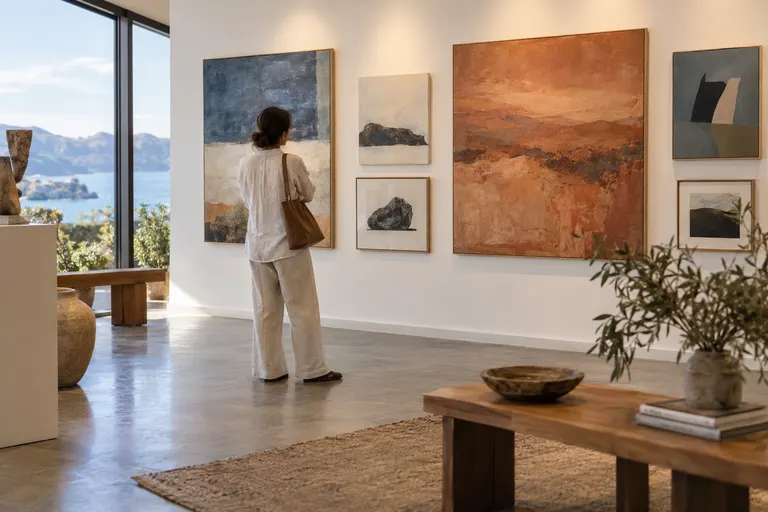
Pacific art is not one style, one movement, or one market. It is a field of practice rooted in the distinct cultures, histories, and diaspora experiences of the many island nations of the Pacific, and it is inseparable from the artists who make it, the materials they use, and the communities they come from. In Aotearoa, Pacific art is a central conversation, not a niche.
What “Pacific art” means in Aotearoa
When galleries, museums, and critics in Aotearoa New Zealand say “Pacific art,” they are usually referring to work by artists of Pacific Island heritage, Samoan, Tongan, Cook Islands Māori, Niuean, Fijian, Tokelauan, Tuvaluan, and others, as well as the broader field of historical and traditional material from the Pacific region. The term covers sculpture, painting, photography, video, performance, textiles, and installation, shaped by distinct island histories, languages, and protocols.
In institutional usage, “Pacific art” often overlaps with “Pasifika” (the term preferred by many artists of Pacific heritage in Aotearoa) and with “Moana” or “Māori and Pacific” as a combined curatorial category. The distinction matters: Māori art is grounded in Te Ao Māorii (the Māori world) and iwi–specific traditions, while Pacific art refers to the many distinct cultures of Samoa, Tonga, Cook Islands, Niue, Tokelau, Tuvalu, Fiji, and other island nations, plus their diasporas in Aotearoa. Treating them as one style erases the differences in language, genealogy, and visual language between, say, a Samoan siapo (barkcloth) and a Tongan ngatu, or between a Māori painter and a Pasifika video artist.
This entry answers “Pacific art” as an art form and collecting subject. It does not cover the former Wallace Arts Centre’s current operations or the James Wallace Arts Trust; for those, contact the Trust directly. It also does not cover the Wallace Arts Trust’s Pah Homestead as a venue; for that, see the relevant venue page.
What “Pacific art” means in practice
In Aotearoa New Zealand, the term “Pacific art” is used in two overlapping ways. The first is the art of the Pacific Islands themselves: objects, textiles, carvings, and work made by artists living in Sāmoa, Tonga, Fiji, Cook Islands, Niue, Tokelau, Tuvalu, Kiribati, and other island nations. The second is Pasifika art: work made by artists of Pacific Island heritage living in Aotearoa, often addressing diaspora, identity, and the relationship between island homelands and urban New Zealand. Both matter, but the emphasis here is on the practice that circulates in Aotearoa’s galleries and institutions.
Pacific art should never be read as one style. The term covers distinct cultural traditions, languages, and histories. A tapa cloth from Tonga, a video work by a Samoan artist in Auckland, and a carved figure from the Solomon Islands are all “Pacific art” in the broadest sense, but they come from different worlds, carry different protocols, and are bought and sold in different ways. Treating them as one market is a category error.
The landscape: institutions and the canon
The institutions that define the historical canon in Aotearoa are Te Papa Tongarewa in Wellington and Auckland Art Gallery Toi o Tāmaki in Auckland. Both hold major national collections and set curatorial standards for how Māori and Pacific work is displayed and interpreted. For work by living artists, Creative New Zealand (the national arts funding body) shapes which artists and projects gain visibility through its grants and strategic priorities (Creative New Zealand, 2024).
The former Wallace Arts Centre at Pah Homestead was a significant private collection housed in a historic mansion in Hillsborough, Auckland. The property is owned by Auckland Council, which also owns the surrounding Monte Cecilia Park. The Wallace Arts Trust established and funded the centre, and its collection formed the core of the exhibitions there. This guide is not the former TSB Bank Wallace Arts Centre or James Wallace Arts Trust; for current operations, contact the Trust directly.
Pacific art: not one style, many conversations
Pacific art is not a single movement or a unified aesthetic. It is a field of practice by artists with heritage across the islands of Polynesia, Melanesia and Micronesia, plus the large diaspora communities in Aotearoa, Australia and the United States. The works share histories of migration, colonisation, language, and oral tradition, but they do not share one visual language. A tapa cloth pattern from Tonga, a Samoan siapo, a Fijian masi, and a video work by a New Zealand–born artist of Tokelauan descent are all “Pacific art,” yet each answers different questions about identity, materials, and audience.
The term “Pacific” or “Pasifika” is used in Aotearoa to refer to artists of Pacific Island heritage, including those born in New Zealand. It is not a single style, nor is it a genre. It is a field of practice that often addresses diaspora, language, and the relationship between island homelands and urban Aotearoa. The most reliable way to approach Pacific art is to treat each artist as an individual voice with their own materials, concerns and communities, rather than assuming a shared aesthetic.
Key names and contexts
Pacific art in Aotearoa spans several generations and media, from painting and sculpture to video, performance, and installation. Some artists work explicitly with customary motifs and materials; others engage with Pacific identity through conceptual or political frameworks.
Artists such as Lisa Reihana have gained international recognition for video and multimedia work that re-examines colonial histories and Māori and Pacific narratives. Her work has been shown at the Venice Biennale. Michael Parekōwhai, a sculptor and conceptual artist, represented Aotearoa at the 2011 Venice Biennale with a series that played with national symbols and museum display. Francis Upritchard creates hand-crafted figures and objects that sit in international collections. Shane Cotton and Peter Robinson both engage with Māori symbolism, colonial history, and the politics of language. Yvonne Todd is known for unsettling, highly constructed portraits. These names are not a fixed canon; they are a starting point for understanding the field’s range, from painting and sculpture to photography and video.
Māori art and Pasifika art are not interchangeable
The term “Pacific art” is often used loosely to cover two distinct fields: art by Māori (tangata whenua, the Indigenous people of Aotearoa) and art by Pasifika peoples from the wider Pacific islands. In Aotearoa, these are separate cultural and legal contexts, and treating them as one “style” is a common error. Māori art is rooted in te ao Māori and has its own protocols (tikanga), materials, and narratives. Pasifika art draws on the diverse cultures of Samoa, Tonga, Fiji, Cook Islands, Niue, Tokelau, Tuvalu, and other island nations, as well as the diasporic experience of Pacific peoples in Aotearoa. Both are current and both are central to the national conversation, but they are not interchangeable. The institutional landscape, Te Papa Tongarewa, Auckland Art Gallery Toi o Tāmaki, and the former Wallace Arts Centre at Pah Homestead, reflects this distinction.
How to approach the work
Start by identifying the artist’s specific heritage and the materials they use. Ask whether the work references customary forms, siapo, ngatu, tivaevae, tatau, or whether it departs from them deliberately. Check exhibition notes and catalogue essays for the artist’s own framing, not just the curator’s label. When you see “Māori and Pacific” grouped together, look for the curatorial reasoning: is the grouping about shared colonial history, or about a specific kaupapa? If the reasoning is absent, question it.
What to skip and what to book
Skip any gallery that presents Pacific art as a single “tribal” or “exotic” category. Book time at Te Papa’s Toi Art gallery and Auckland Art Gallery’s Mackelvie Gallery, where the curatorial distinctions between Māori and Pacific works are visible in the hang. For living artists, check the Creative New Zealand funded projects list and the Pasifika Festival programme in Auckland, which often includes visual arts alongside performance. If you are buying, ask the dealer to name the artist’s island affiliation and to confirm that the work was made with the artist’s consent and, where relevant, community permission.
Read next
-
Māori art
Māori art is the foundational visual culture of Aotearoa New Zealand, a living tradition that spans carving, weaving, painting and work in video, sculpture and installation.
-
Painting
Painting in Aotearoa New Zealand is not a single market or a single style.
-
Works on paper
Works on paper is the quiet backbone of almost every serious art collection in Aotearoa New Zealand.
-
Fine-art prints
A fine-art print is not a poster, an inkjet copy of an oil painting, or a page torn from a book.
-
Photography
Photography in Aotearoa New Zealand occupies a distinctive place in the art market, one where the physical object is only part of the story.
-
Sculpture
Sculpture in Aotearoa New Zealand is not a single medium but a conversation about land, identity, and the body.